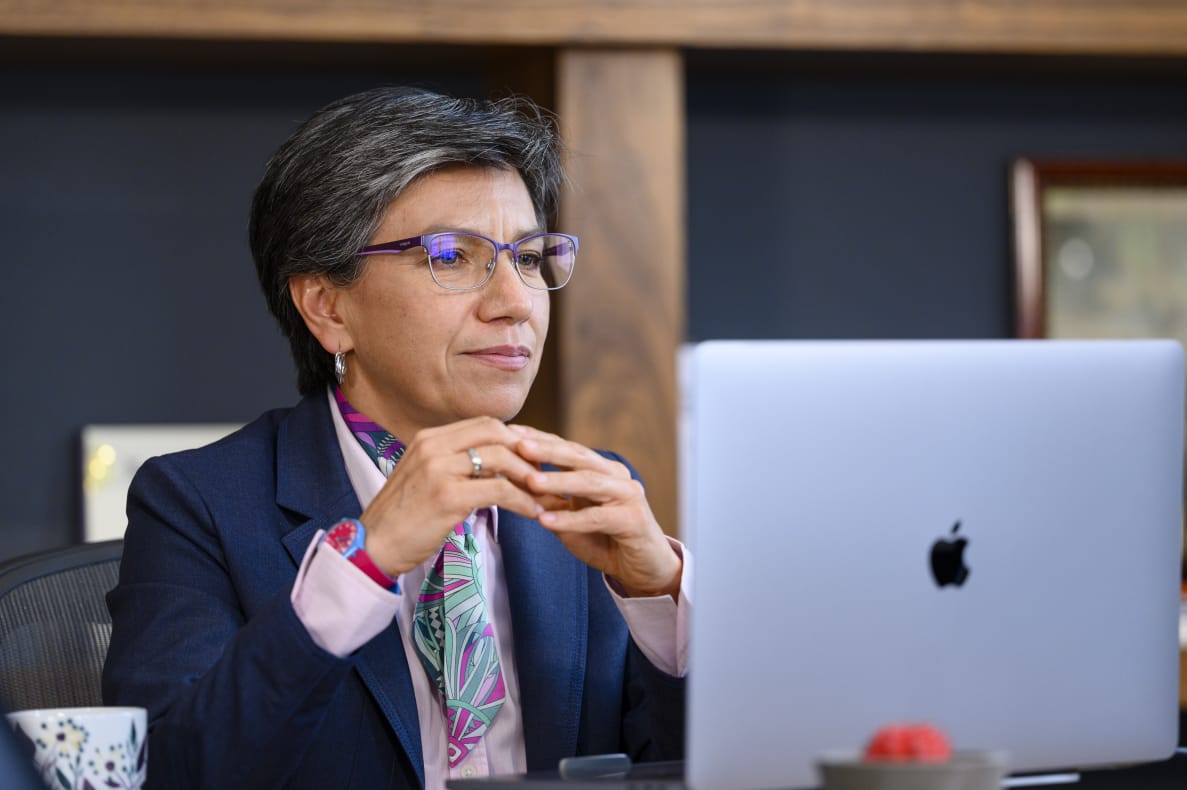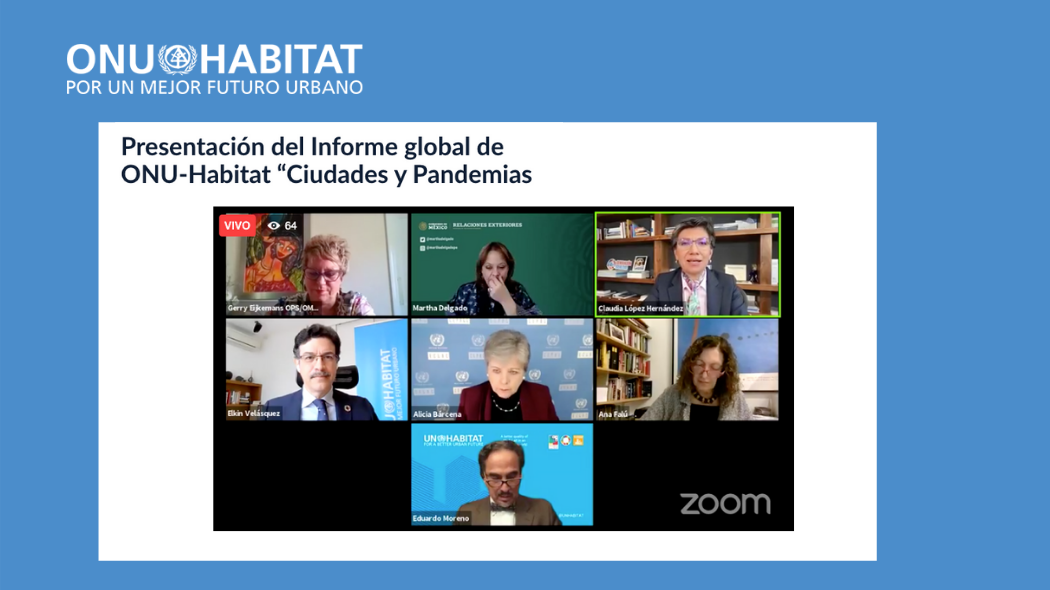

The Mayor of Bogotá, Claudia López participated in the launch to Latin America of, “Cities and Pandemics: Towards a More Just, Green and Healthy Future.” A global study by UN Habitat.
This report offers a global view of cities and the people that have been impacted by COVID-19 and the lessons learned after nearly sixteen months of COVID-related restrictions. The report presents a global landscape of where we stand and where we need to go to ensure a lasting and sustainable recovery.
In her speech, the Mayor of Bogotá spoke of healing through the implementation of a Social Contract as a response to the pandemic, "We have had a pandemic, an economic crisis and social upheaval, one after another. Bogotá has to move on from the Social Contract to Social Rescue. Sadly, this contract would’ve benefitted greatly in the long-term, but people need answers today, now. Some emergencies simply cannot wait," stated the mayor.
“The first move that must be taken," continued Mrs. López, “is evaluating how Bogotá will respond to the demands of its young protestors, who have been marching in the streets for more than a month and a half. Unsurprisingly, we have seen a sudden spike of contagion, but some demands couldn’t wait. The first thing we have done is re-direct investment priorities, we have had to sacrifice road-work and transportation projects for the time being. The holes in the street can wait, the holes in their bellies cannot,” said the Mayor Claudia López.
The Mayor participated in the official presentation of the report alongside an impressive panel. Consisting of Maimunah Mohd Sharif, executive director of UN Habitat; Alicia Bárcena, Executive Secretary of ECLAC; Elkin Velásquez, director of UN-Habitat for Latin America and the Caribbean; Martha Delgado, Undersecretary for Multilateral Affairs and Human Rights at Mexico’s Ministry of Foreign Affairs; Eduardo López Moreno, director for Innovation and Knowledge of UN-Habitat and Luis Felipe López Calva, regional director of UNDP.
Executive Secretary Alicia Bárcena, gave an account of life after a year and a half since the emergence of COVID-19. According to Secretary Bárcena, Latin America has seen a fall of 7.1% of Gross Domestic Product (GDP). This pandemic has undoubtedly caused unemployment to rise, especially among the more vulnerable and dis-advantaged groups which caused more than 3 million companies to go out of business. "Furthermore, the pandemic has set us back 12 years in terms of combating poverty, and 20 years in the case of extreme poverty. It has gotten so bad that we have witnessed nearly 46 million households that do not have internet access," stated Mrs. Bárcena.
Mrs. Barcena then warned about the risk of a divergent asymmetric recovery due to unequal access to vaccines against COVID-19, "this fractures us even more on the international stage," the secretary went on to say.
In turn, Mrs. Martha Delgado, Mexico's Undersecretary of Mutual Affairs and Human Rights, praised the report as deep reflection on how Latin America has managed this disease. "This effort also aims to make a stand and re-organise the agenda to face serious health problems, and of course to thank the UN Habitat. Which has been a global leader in its approach to these problems that are widespread all-throughout," said the Mexican undersecretary.
Mrs. Delgado then added that "the world has had to suddenly adapt to circumstances that have blind-sided us, especially those on the front line of this crisis." On the Mayor’s task of managing the city during a pandemic, Mrs. Delgado said, "We are seeing in Claudia López one of the best mayors in the world." She then praised the efforts on behalf of UN Habitat, "it has been very important to provide to-the-minute information, planning tools for the development of urban policies that promote sustainable recovery." According to the report, since the start of the pandemic, cities have been on the front line of the worst that COVID-19 has had to offer. However, in the subsequent months, the challenges of the pandemic and its toll on the city have evolved, alongside the disease itself. Taking this new landscape into account, the report touches on the following points:
- Re-thinking the form and function of the city, not only in the face of the pandemic, but also to make it more sustainable and productive, through inclusive planning.
- Address systemic poverty and inequality, to mitigate the dis-proportionate impact of COVID-19 and thus address the underlying causes of social exclusion.
- Rebuild a 'new' urban economy, emphasising the transition to greener and more equitable economies.
- Clarify legislation and governance of cities, with the aim of developing more flexible and innovative institutional and financial frameworks.
According to the report, even though there is no single model to successfully overcome this crisis, steps have been implemented by cities and regions around the world to deal with the virus and that are worth noting:
- Clear commitment to enforce public health measures.
- Multi-lateral strategies to address different dimensions of the pandemic, especially among the most vulnerable and isolated demographics.
- Emphasis on community participation and learning.
- A creative adaptation to the new circumstances of COVID-19
- Focus not only on survival, but also recovery.
According to UN-Habitat, these bullet-points highlight the need to move from an emergency mentality to one of recovery. To create a space where cities have the opportunity to continue strengthening public health, economic resilience and access to services for all its citizens.
The global report concludes stating that, “the divisions and inequalities revealed by the pandemic mean that it isn’t simply enough returning to normalcy, now a revolutionary change is needed, with inclusive policies, the commitment of the community as a whole and meaningful leadership. If all of these points meet then we can move towards a more sustainable approach, to leave the grip of the COVID-19 catastrophe stronger and more resistant than before.”