Traslated by Andrés Martínez Forero
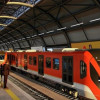
This is where it happens: in ‘Bogotá, My City, My Home’, Line 1 of the Bogotá Metro keeps moving forward! After a month-long journey from Qingdao, China, the six cars that make up the first Line 1 train arrived in Cartagena, Bolívar, on their way to Colombia’s capital.
You may be interested in: Metro Systems from L.A., Madrid, Quito, San Francisco, and More Congratulate Bogotá on Its First Line 1 Train
Mayor Carlos Fernando Galán celebrated this milestone and shared a message with the country:
“Thanks to everyone who made this possible. Our message to Colombia is clear: yes, we can deliver major infrastructure projects that transform lives. We’ll keep building them because that’s what Colombia needs—unity. This project proves we can come together to face challenges and overcome them.”
The arrival of the first train marks a turning point for Colombia’s most important mobility project and one of Latin America’s largest infrastructure works. By August 6, 2025, construction had already reached 60% completion.
Mayor Galán emphasized the importance of this achievement in a message shared on the city’s official X account:
"Es un hito para el país. El Metro de Bogotá es el metro de todos los colombianos y, por eso, alcanzar este avance tan importante representa un momento de esperanza para Colombia y una demostración de que este país puede lograr grandes cosas": @CarlosFGalan, alcalde Mayor de… pic.twitter.com/srBa0gEutC
— Alcaldía de Bogotá (@Bogota) September 2, 2025
“This is a reward for the city, and we can’t delay it. Our commitment is to start commercial operation in March 2028, together with Bogotá’s integrated transport system,” said Leonidas Narváez, General Manager of Empresa Metro de Bogotá (EMB). He also confirmed that the second train left Qingdao in early August 2025 and will arrive in Colombia in about four weeks.
Because the trains travel disassembled, the six cars shipped separately and will be coupled at the Bosa Yard and Workshop in Bogotá.
Unloading the train from the ship to the flatbed trailer took about eight hours. The process included inspection, crane lifting, positioning, and securing the train onto a specialized platform for overland transport.
Once in Bogotá, the train will undergo static and dynamic testing on 905 meters of test track at Bosa Yard.
The first train took ten months to build, beginning in mid-2024. Key stages included:
- Assembling the car structures.
- Painting and finishing.
- Installing equipment.
After completing the prototype, engineers carried out preliminary testing followed by a 2,500-kilometer trial run. Each train measures 134 meters long, 2.9 meters wide, and 3.9 meters tall, and includes six cars: two end cars (type S) and four central cars (type M).
Key features
- Driverless operation: 100% automated trains.
- Energy recovery: Up to 35% of the energy from braking powers other trains via the third rail.
- Travel time: Just 27 minutes from Station 1 (Bosa) to Station 16 (Caracas Ave. with Calle 72) — a trip that currently takes up to two hours.
- Frequency: Trains will run every 140 seconds in both directions on independent tracks.
- Capacity: 300 passengers per car, or 1,800 passengers per train.
- Accessibility: Two wheelchair spaces per car.
Additional Technical Details
- Average commercial speed: 42.5 km/h.
- 252 seats, including 36 priority seats for pregnant women, seniors, and parents with small children.
- Train and station doors built with top safety standards.
- 24 doors per train (four per side, per car) for easy boarding.
- Fire-resistant seating materials.
- Weight sensors to ensure safe passenger conditions.
Don't leave without knowing: Bogotá Joins the Top 100 Best Cities in the World for Studying
Relive the moment: Watch the first Line 1 train’s arrival on the Bogotá Mayor’s Office YouTube channel:
*This article was created using information provided by the Bogotá’s International Relations Office and curated by a journalist from Portal Bogotá. For suggestions, questions, or more information, visit Bogotá Te Escucha: https://bogota.gov.co/sdqs/