
Traslated by Andrés Martínez Forero
‘Bogotá, My City, My Home’ continues to build strong partnerships to accelerate progress in air quality management. Secretariat of Environment of Bogotá and the Stockholm Environment Institute (SEI) have renewed a Memorandum of Understanding (MoU) on technical cooperation aimed at strengthening the city’s ability to monitor and evaluate integrated environmental policies — with a particular focus on air quality, climate change, and associated public health benefits for residents.
You might be interested in: The Guardian spotlights Bogotá as a global example in the fight against air pollution
The agreement establishes a technical cooperation framework to assess emission-reduction scenarios across multiple sectors and reinforce the city’s monitoring tools to evaluate the impact of flagship initiatives such as the Urban Zones for Better Air (ZUMA). This comprehensive strategy is designed to curb air pollution and protect public health in densely populated areas facing high levels of contamination.
Under the administration of Mayor Carlos Fernando Galán, the first ZUMA was launched in the Bosa–Apogeo neighborhood. In collaboration with the local community, targeted interventions are already underway, including road paving, urban renaturalization and greening, and the installation of air quality monitoring systems to measure the tangible impact of these improvements.
“In Bogotá, we are implementing major interventions to address air quality challenges — particularly in the southwest of the city — through the Urban Zones for Better Air and the Freight Transport Technology Access Fund (Foncarga). These initiatives will help reduce the two primary sources of PM2.5 emissions, which pose the greatest risk to public health,” said Adriana Soto, Bogotá’s Secretary of Environment.
Through this renewed Memorandum of Understanding, institutional capacity will be further embedded within the Secretariat of Environment to assess the impact of Air Plan 2030 projects in mitigating atmospheric pollutant emissions.
“This partnership with the Stockholm Environment Institute allows us not only to measure the impact of our interventions in the southwest of the city — including renaturalization, greening, and road paving, a major source of particulate matter — but also to evaluate the effectiveness of freight transport modernization. Importantly, it also enables us to assess public health outcomes, advancing environmental and social justice in the southwest of Bogotá,” Secretary Soto added.
Air Plan 2030 serves as Bogotá’s central policy framework for managing and reducing air pollutant concentrations, with the ultimate goal of improving public health and overall well-being. Three years ago, SEI and the Secretariat of Environment signed their first Memorandum of Understanding to implement the Long-range Energy Alternatives Planning (LEAP) system, designed to evaluate emission mitigation scenarios linked to Air Plan 2030 measures.
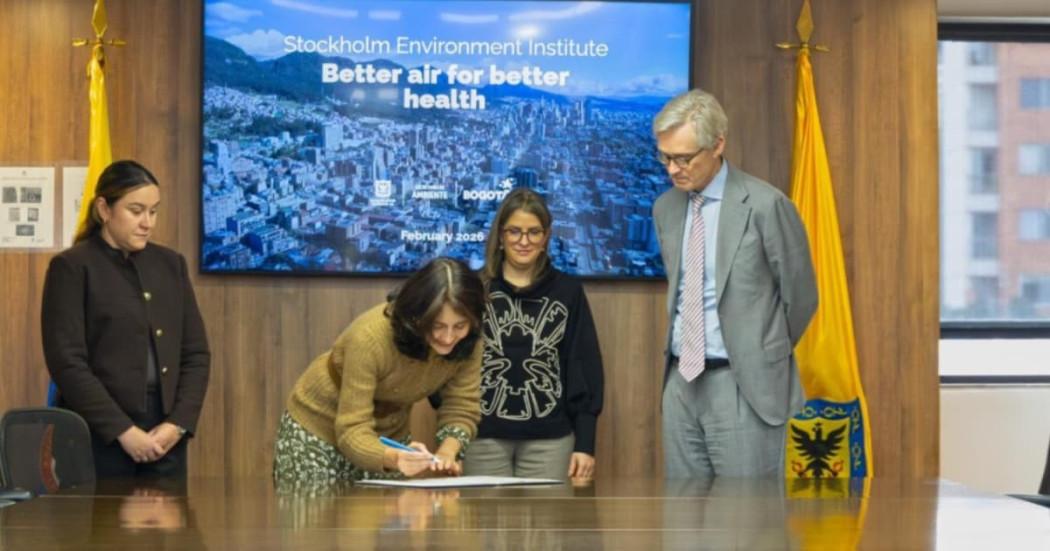
“I am very pleased to renew and sign this Memorandum of Understanding once again with the city of Bogotá. The important work being carried out here on air quality — particularly in vulnerable communities — goes to the heart of sustainable urban development challenges. At the Stockholm Environment Institute, we have addressed these issues in cities around the world, and we are extremely honored to collaborate and provide the analytical tools and expertise that support the vital work being undertaken here,” said Måns Nilsson, Executive Director of SEI, during the signing ceremony.
The signing ceremony, held at the headquarters of Secretariat of Environment of Bogotá, was also attended by Silvia Calderón, Director of SEI’s Latin America Center, along with members of the technical teams from the Secretariats of Environment and Health.
*This article was created using information provided by the Bogotá’s International Relations Office and curated by a journalist from Portal Bogotá. For suggestions, questions, or more information, visit Bogotá Te Escucha: https://bogota.gov.co/sdqs/